
As AI Enters Medical Decision-Making, Where Will Healthcare Companies Find New Growth Opportunities?
DXY Executive Forum Explores Shifts in Physician Decision-Making and the Future of Healthcare Growth
DXY Executive Forum Explores Shifts in Physician Decision-Making and the Future of Healthcare Growth
On July 28, DXY hosted the second DXY Executive Forum, "AI in Medicine: Powering Intelligent Growth," together with the launch of the Chinese Physician Survey on AI Behaviors and Attitudes (2026), in Shanghai. The event brought together representatives from consulting firms, leading pharmaceutical companies and hospitals, and top-tier journals, along with more than 300 guests from across the healthcare industry, to discuss a question that is profoundly reshaping the sector: As AI enters medical decision-making, how will growth strategies for healthcare companies evolve, and where will the next breakthrough come from?
At the event, DXY formally released the Chinese Physician Survey on AI Behaviors and Attitudes (2026). McKinsey & Company contributed the questionnaire design and analytical interpretation. Drawing on 4,150 valid responses from physicians on the DXY platform, the report covers physicians across hospital tiers, specialties, and age groups. It systematically analyzes physicians' AI usage habits in China, perceptions of AI's value, physician-patient interactions, and pharmaceutical and medical information-seeking behavior, providing first-hand clinical insights for the healthcare AI sector and for pharmaceutical and medical-device companies.
Nearly 80% of physicians are already using AI at work. Frequent use has become routine in clinical practice
Opening the event, DXY Vice President Lulu Cong delivered remarks titled "AI in Medicine: When Physicians Start Asking AI." She noted that over the past year, AI has advanced in healthcare far faster than the industry expected. From clinical decision-making and research writing to patient education and knowledge acquisition, more physicians are incorporating AI into their daily workflows. These changes in physician behavior are also driving a broader restructuring of the healthcare ecosystem.

Next, Xuesong Peng , Senior Partner at McKinsey & Company, formally released and presented the Chinese Physician Survey on AI Behaviors and Attitudes (2026). The report shows that nearly 80% of physicians are already using AI in their work, broadly on par with the 81% adoption rate found in a U.S. survey. Approximately 75% of physicians use AI tools every day. AI is now deeply embedded across the full spectrum of their daily clinical, research, and teaching activities, and its use has become an established work habit.

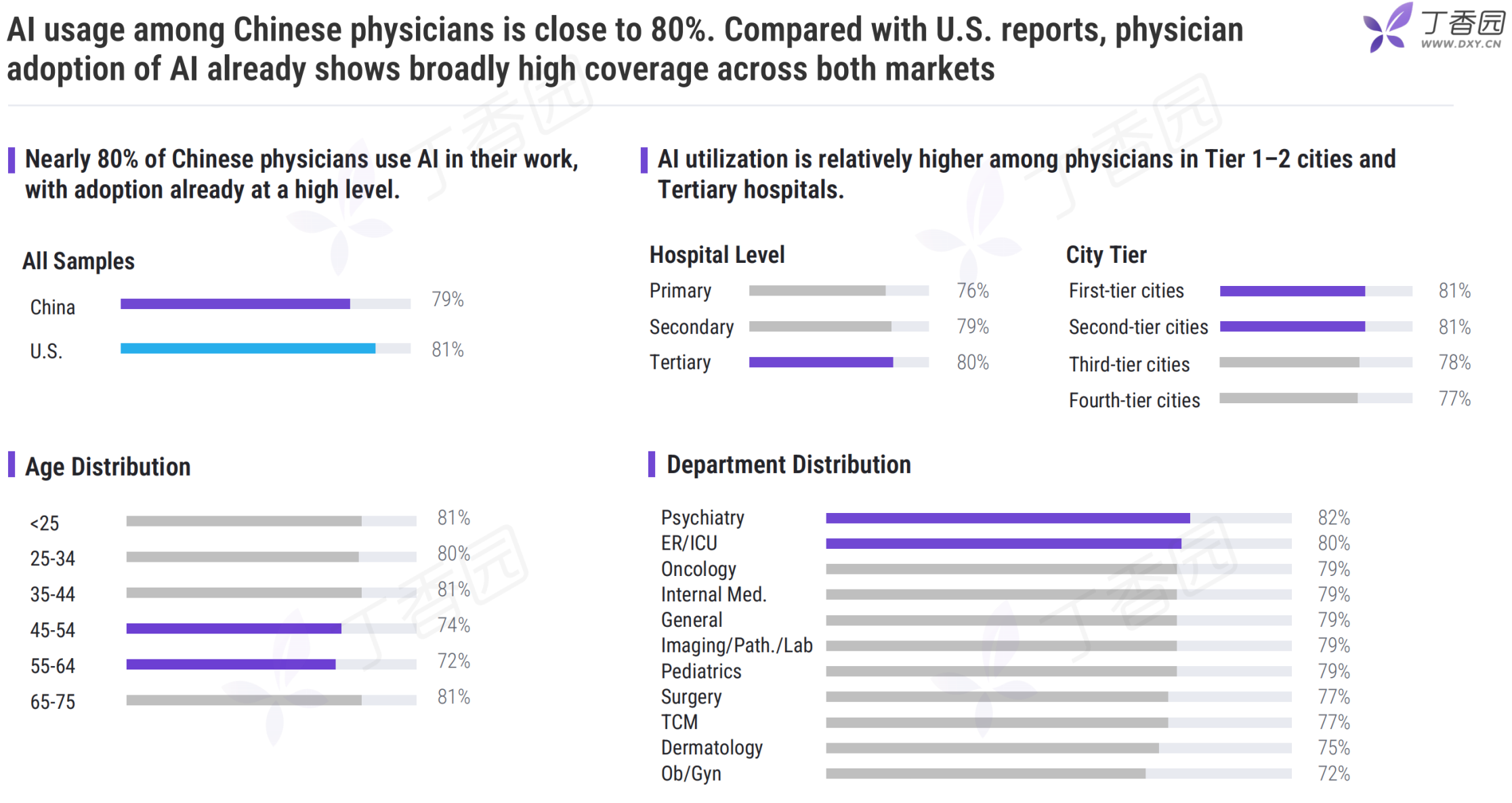
By specialty, AI use is most frequent among physicians in oncology, radiology/pathology/laboratory medicine, and dermatology; 84% of oncologists use AI every day. Clinical decision-making, diagnostic support, and lecture content creation are currently the three use cases with the highest awareness and adoption, while AI continues to gain ground in areas such as medical-record generation, patient management, and medical insurance services, where substantial room for further adoption remains.
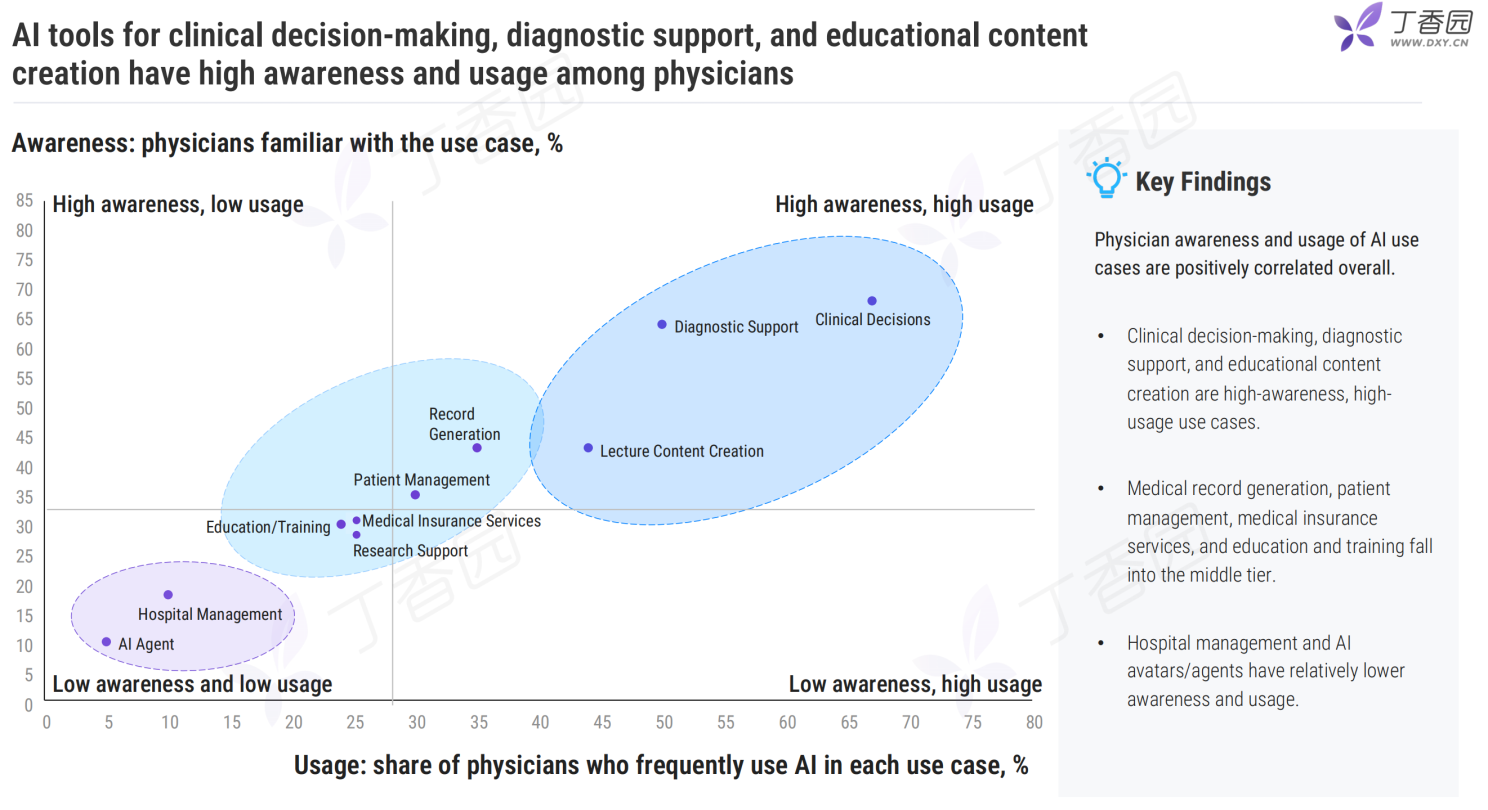
The report also shows a clearer division of roles among different types of AI tools. General-purpose AI is used more often for workflow tasks such as research support and lecture content creation. Specialized medical AI has an advantage in areas that depend on processes, rules, and systems integration, including patient management, medical insurance services, and hospital management. AI is gradually evolving from a standalone tool into a network of capabilities spanning physicians' entire workflow.
AI Reshapes Clinical Decision-Making. From "Information Retrieval" to "Human-AI Collaborative Decision-Making"
As AI evolves from a tool into a partner, it is not only improving efficiency but also reshaping how physicians make decisions.
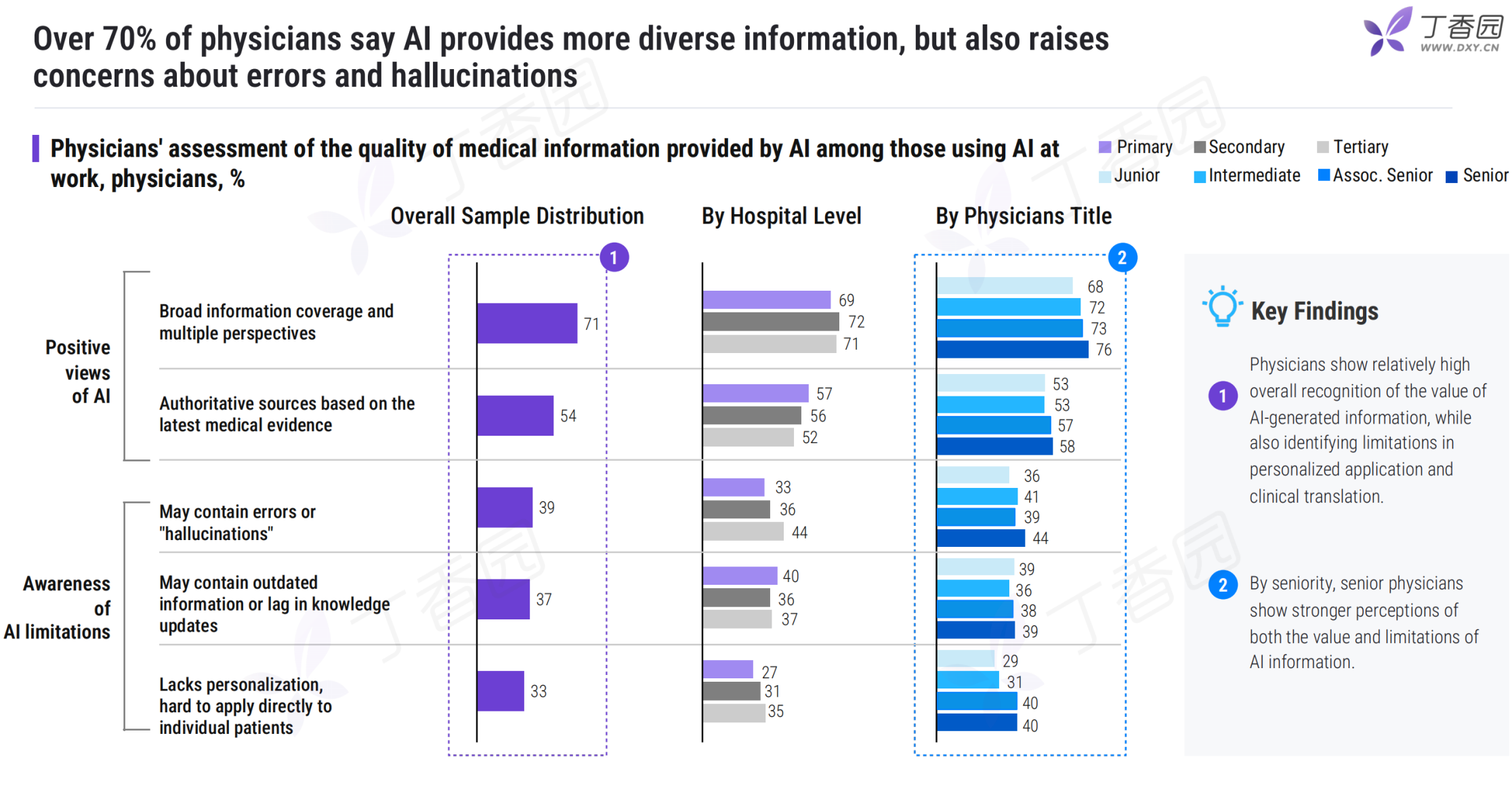
The Chinese Physician Survey on AI Behaviors and Attitudes (2026) shows that clinical decision-making has become one of the most widely used and central applications of AI for physicians. More than half of frequent AI users say that AI has significantly improved their efficiency. At the same time, physicians' views of AI are becoming more measured. More senior physicians perceive greater value in AI's ability to improve efficiency, diversify information sources, and reduce repetitive work, while also being better able to recognize limitations such as limited personalization and response accuracy.
Tiantian Li , Founder and Chairman of DXY, shared his latest observations on changes in physicians' clinical decision-making in the AI era, drawing on behavioral data from millions of users of the DXY ClinMaster app. He noted that patients are beginning to arrive at consultations with AI-generated recommendations, while physicians are frequently using AI to look up medication information, search the literature, and support clinical decisions. AI is reshaping the information dynamic between physicians and patients and making "decision alignment" a new priority for the industry.
Li said AI's value lies not in replacing physicians, but in helping them access evidence and interpret guidelines more efficiently while reducing the risk of errors, bringing clinical decisions closer to clinical consensus. The continued accumulation of real-world physician behavioral data is also becoming an important window into the future development of healthcare.

Meanwhile, changes on the patient side are also influencing the clinical decision-making process. The report shows that nearly 60% of physicians frequently encounter patients bringing AI-generated diagnostic or treatment advice for consultation, while more than 70% support the use of AI in physician-patient communication and shared decision-making. Overall, physicians favor AI-assisted decision support under physician guidance.
As one of the earliest areas to adopt medical AI, medical imaging offers an important practical model for AI-assisted decision-making. Fuxin Ren, Chief Physician at Shandong Provincial Hospital, said that AI can already handle some standardized image-reading tasks and help physicians work more efficiently. Its value, however, lies not in replacing physicians but in freeing them to devote more attention to complex-case analysis and clinical decisions. Physicians' role is shifting from "image reader" to "AI orchestrator."

From asking AI and using AI to collaborating with AI on decisions, physicians in China are undergoing a profound transformation in how they work.
AI-Driven Restructuring of the Value Chain. New Growth Opportunities Behind Changes in Physician Behavior
AI is not only changing how physicians work; it is also reshaping how pharmaceutical companies engage with them.
The report finds that professional medical platforms and the medical literature remain physicians' primary sources of drug information. AI is used as a drug-information source by 24% of physicians; 31% still obtain relevant information from pharmaceutical representatives or medical liaisons, and 75% consider the information provided by pharmaceutical representatives very or generally effective.
These findings indicate that the rapid growth of AI has not diminished physicians' need for specialized, trustworthy medical information; instead, it has raised their expectations for information quality and service value. For pharmaceutical companies, finding ways to continue creating value in this new information ecosystem is becoming an important industry priority.
On this topic, Dake Zhang, Executive Deputy Editor of Innovation Medicine/Life, discussed AI's impact on the production of medical knowledge. He argued that AI is reshaping medical research and scholarly communication. While increasing efficiency, it is also posing new challenges to academic standards and the capacity for innovation. Finding a new balance between efficiency and rigor will be a central issue for the ecosystem of medical scholarship.

At the other end of the pharmaceutical value chain, AI is also driving an evolution in decision-making models for drug-development intelligence. Weiwei Mi, Head of the Innovative Drug Data Department for the DXY Insight Database, shared examples of AI applications in drug-development intelligence analysis. With AI, information collection and analysis that once took days can be completed in far less time, giving pharmaceutical companies faster and more efficient support for R&D project evaluation and initiation, competitive-landscape analysis, and strategic decision-making. AI is gradually evolving from an information-processing tool into an important aid to corporate decision-making.

Changes in physician decision-making are also transforming pharmaceutical marketing models. Wenhao Wang, Director of Digital Marketing at DXY, said that as the ways physicians obtain information, acquire knowledge, and make decisions change, companies must update their growth strategies accordingly. Using AI and digital capabilities, companies can understand the needs of different physician segments more precisely, deliver more targeted scientific engagement and content services, and shift marketing from "broad reach" to "precise engagement."

During a panel discussion, representatives from Sanofi, Roche Pharmaceuticals, Allergan Aesthetics, and Hengrui Pharmaceuticals discussed applications of AI across R&D, medical affairs, marketing, and operations. Panelists agreed that AI is moving beyond isolated point solutions toward organization-wide capabilities. The key to future competitiveness will not be whether a company uses AI, but whether it can embed AI deeply in core business processes to create genuine value.

As a leading digital healthcare technology company in China, DXY has long tracked the healthcare industry's digital transformation. The newly released Chinese Physician Survey on AI Behaviors and Attitudes (2026) is not only a survey of the current state of AI adoption, but also an important snapshot of changing physician behavior.
As nearly four in five physicians are now using AI at work, patients arrive at consultations with AI-generated recommendations, and the dissemination of pharmaceutical and medical information is redefined, a new era of healthcare is rapidly taking shape. For the industry, the key question may no longer be whether AI will change healthcare, but how to understand that change and seize the opportunities it creates.
As AI reshapes the healthcare ecosystem, only by understanding physicians and the forces of change can the industry see where growth will come from.